
Legal updates and opinions
Post Author

News / News
A Fiesta of Sports and IP
Over the past month or so, the world has been spoilt for choice with fiesta of sporting events from WIMBLEDON to the UEFA EURO’s. And it has to be mentioned that the Spanish were victorious in both events – with commiserations to the English fans!
Behind all of the sport, trade marks and intellectual property play a significant role. The well-known WIMBLEDON logo is instantly recognisable even if WIMBLEDON were to be excluded from the mark –
On the topic of WIMBLEDON, we celebrate the achievements of Kgothatso Montjane, who secured the Ladies’ Wheelchair Doubles title. This is a proud moment for the country.
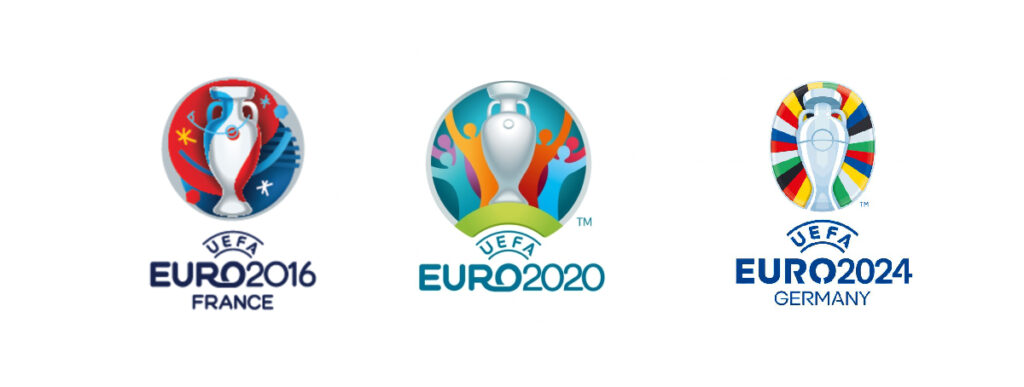
It has been reported that the UEFA EURO 2024 hosted by Germany was seen by 5 billion viewers. Although the EURO’s logo is amended slightly depending on the host country, it is also easily recognisable as shown below –
On home turf, we have the rugby home tests with Irish, Portuguese, New Zealand and Argentina gracing our shores which is always a source of excitement and part of the social fabric, with South Africans standing behind the SPRINGBOK trade marks, with the following mark needing no explanation –
The South African Rugby Union is vigilant in the protection of its trade marks against unauthorised use which includes an extensive anti-counterfeiting program which includes customs being empowered to detain goods which are suspected to be counterfeit, which leads to the seizure thereof if found to be unauthorised. Additional steps include regular monitoring of authorised usage in the market place, on social media and other platforms.
A further sporting extravaganza to look forward to is the Olympic Games, to be hosted in Paris from 26 July 2024. The International Olympic Committee (“IOC”) is serious about the protection of its marks and symbols, having its own Olympic Charter which has a section on the “Rights over the Olympic Games and properties” which includes the Olympic symbol, flag, motto, emblems, anthem, flame and torches. A country hosting the Olympic Games must enforce the guidelines by either promulgating new legislation or amending existing laws to assist with the protection of Olympic Properties.
Although the local French legislation will not extend to South Africa, do not be tempted to use the OLYMPIC trade marks and other Olympic Properties, such as the well-known 5 interlaced rings logo, as the IOC has registered a number of trade marks in South Africa for a wide range of goods and services.
A final word on the subject of sport and Spain, according to reports, before Kylian Mbappé’s move to Real Madrid, he applied to trade mark his name ‘Mbappé’, and filed a new application for his goal celebration, being an image of his celebration which was previously trade marked showing a figure in black, white, and grey, frozen in motion with a smiling pose, crossed arms, and hands under the armpits. We do realise that Mbappé is French but his move to Real Madrid is significant if consideration is also had to the fact that as of May 2024, Forbes valued Real Madrid as the world’s most valuable soccer club brand, at $6.6 billion.

Advice should be obtained before using proprietary trade marks, not only to avoid litigation proceedings but also to respect the time, effort and money which trade mark owners have spent which have resulted in them becoming recognised and admired around the world.
Latest News
The Employment Equity Amendment Bill, 2018
By Jacques van Wyk, Director and Yusha Davidson, Candidate Attorney The Employment Equity Amendment Bill, 2018 ("Bill") amends specific provisions [...]
Five reasons to register trade marks beyond your home territory
In our September 2017 edition of Legal Werks, the top ten reasons to register trade marks were identified notably the [...]
Is an employee able to avoid a disciplinary hearing or disciplinary sanction by resigning?
It is trite law that employees may resign from his employment, either with immediate effect or on notice, thereby unilaterally [...]
Paternity leave
By Jacques van Wyk, Director and Yusha Davidson, Candidate Attorney The Basic Conditions of Employment Act 75 of 1997 ("BCEA") [...]
Struggle songs in the workplace
By Jacques van Wyk, Director and Yusha Davidson, Candidate Attorney ISSUE Is the singing of struggle songs in the workplace [...]
Draft Employment Equity Regulations, 2018
By Jacques van Wyk, Director and Yusha Davidson, Candidate Attorney The Minister of Labour has published the Draft Employment Equity [...]



